


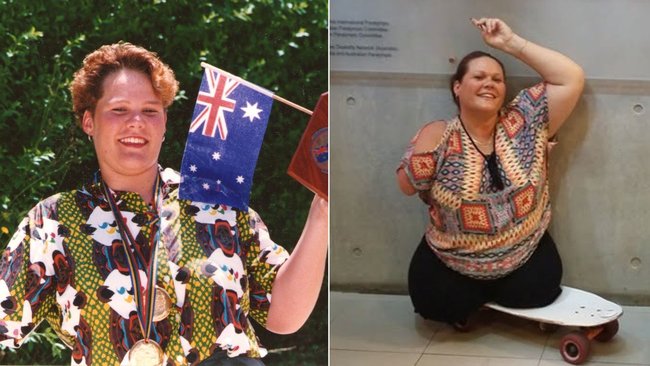
She won two gold medals at the Paralympics but now Tracy Barrell OAM has been stripped of 96 per cent of her NDIS funding.
The First Nations mother-of-two had been receiving 24/7 care for four years, but for the last two weeks she has been funded for just two hours of care a day — care she needs to eat, shower, get dressed, and get out of the house.
As a teen, Barrell brought home two gold medals for Australia — winning butterfly and freestyle swimming races in the 1992 Barcelona Paralympics, and a bronze medal in the 1994 World Championships.
Know the news with the 7NEWS app: Download today
She was also the face of the National Disability Insurance Scheme in NSW when it was first introduced.
Now, the 52-year-old is fighting to have her dignity recognised by the same scheme she helped advocate for.
“After all the contributions I’ve made in all my years, representing Australia, winning gold medals, receiving the (Order of Australia) medal, raising two kids on my own … I’ve just been stripped of everything for no reason,” Barrell told 7NEWS.com.au.
Born without legs and with only one arm, Barrell has spent her whole life disproving misconceptions about what she is capable of.
For more than 20 years, Barrell famously used a skateboard to get around.
Now she usually uses a wheelchair, but requires assistance to get in and out of it — just as she needs help to get into her car and her bed, which recently broke.


It was Barrell’s “change of circumstances” application for a new in-home hospital bed that triggered the NDIS decision to cut her plan.
“They decided that because they were going to pay for the bed, the $6000 bed, that I no longer needed the 24/7 care,” she said.
Without 24/7 care, Barrell’s medical specialists say she is at a high risk of falls, pressure sores and depression — her functional capacity report is 21 pages long.
“If I’m stuck with this plan, I will just end up in hospital,” Barrell said.
“That’s not anyone’s dream.”
A legend slips through the cracks
Barrell did not receive NDIS support for the first 42 years of her life.
Even when the money would have been useful as she raised two young children as a single mother, NDIS eligibility criteria locked her out. Her choice to use a skateboard instead of a wheelchair was just one of the reasons she was knocked back.
But a lifetime of reliance on her one arm has now impacted her ability to use it.
“The only thing I’ve got left is failing me,” Barrell said.
“Because of my physical body and using the one arm my whole life, I’ve put so much pressure on my spine and it’s just crumbling now because it can’t support itself as I’m aging.
“Some days I can’t even use my arm — my carers have to feed me and wipe my face.
“I’m having to come to terms with what my life is at the moment, and having this stress of not being financed to be able to still live a dignified life.”

Barrell was the first female First Nations Paralympian to bring home gold, but her work encouraging First Nations people with disabilities to engage in sport did not end there.
She was in the working group to establish Paralympics Australia’s Reconciliation Action Plan, is on the board of the National Indigenous Sports Foundation, and was elected to Paralympics Australia’s Athlete Commission in 2024.
During the original rollout of the NDIS, Barrell was also the NDIS representative for Aboriginal people with disabilities.
“I was going around to Aboriginal communities to help them understand what was happening and to show them it was going to be OK,” she said.
On her new NDIS plan, Barrell will only have enough funding to hire carers to help with things such as getting doctor’s appointments and supermarkets.
She said she will have to bank up her funding for a single trip outside the house each week, and will not be able to be involved in her Indigenous community at all.
The independence she once used to help change the country has now been ”completely stripped away,” she said.
“I’m just nothing. I’m just devalued. I’m a nothing.”
No time to dispute the decision
The cuts to Barrell’s plan are not the result of proposed NDIS cuts.
But Barrell worries how a “standardised” eligibility process outlined in looming legislation might leave participants vulnerable to similar decisions, and how potentially automated systems could impact their ability to appeal them.
An NDIA spokesperson told 7NEWS.com.au: “Participants have the right to request a review of Agency decisions.
“The NDIA remains in contact with participants and their representatives throughout planning and review processes to explain decisions, funding arrangements and any requirements that may apply.
“This includes relevant assessments and checks to ensure supports, including Home and Living supports, are appropriate to a participant’s circumstances.”
But Barrell said while the NDIA “might have the framework for that outcome” that was not her experience.
“When we got the decision about my plan being dropped, we were not afforded the 21 days that we asked for to be able to present our new report,” she said.
Barrell said an NDIA officer was going to send her an outline of the new plan to look over “so we knew what we were dealing with, yet she didn’t do that either … she just closed off my previous plan”.
She is now fundraising to pay for the carers she needs until she is “able to have this ridiculous NDIS decision overturned”.
The NDIA cannot comment on individual circumstances but told 7NEWS.com.au: “The NDIA’s priority is ensuring every participant has access to the disability-related supports they need.”
Human rights concerns raised
When asked about the proposed NDIS cuts, Barrell said: “The looming legislation just makes me feel sick because they don’t have the right people in the room talking to them.”
Her comments come as National Disability Discrimination Commissioner Rosemary Kayess has called on the government to take heed of human rights concerns raised by the Parliamentary Joint Committee on Human Rights (PJCHR).
“The PJCHR findings reflect our concerns that the cumulative impact of these changes could amount to an interference or regression on the rights of people with disability in Australia,” Kayess said on Wednesday.
“The NDIS was designed to allow people with disability to live independently and participate fully in the community — to give them support to make choices and have control over their lives.
“The proposed amendments risk these supports and the full inclusion of people with disability in society.
“The changes proposed in the Bill strip back the human rights underpinning the scheme.”
Reduced access to supports, reduced choice, control and individualisation, and a return to an outdated view that disability is a medical problem to be treated and a cost to be managed, were all issues raised by the Commission in its submission to the Senate inquiry.
She has asked Disability Minister Mark Butler to explain how the reform aligns with Australia’s commitments under the UN Convention on the Rights of Persons with Disabilities.
“The government must be clear about how they are considering and protecting human rights with NDIS reform,” Kayess said.


