



The Hungarian Parliament Building and Szechenyi Lanchid or Chain Bridge in Budapest, Hungary.
Schroptschop | E+ | Getty Images
Last month I spent two days exploring the Hungarian capital of Budapest, discovering grand architecture, great food, spa culture and beautiful views along the Danube River.
Buildings drip with embellishments; monuments to the city’s writers, artists and musicians seem to be on every corner, and the public transit system and plentiful taxis made for a fun and easy whistle-stop tour of some of Budapest’s main sites.
Day one: Churches, a castle and cake
To get oriented, I headed to St Stephen’s Basilica, a neoclassical cathedral named after the first king of Hungary and consecrated in 1905 after more than 50 years of construction. At nearly 100 meters high, its dome is worth the climb (or take the elevator) for a 360-degree view, including the Castle District and Parliament on either side of the river, and the Buda Hills beyond.
I also visited the Treasury museum, where an early 1900s oil sketch by Hungarian artist Gyula Benczúr — designer of the mosaics above the cathedral’s main altar — was a highlight. Inside the cathedral’s nave, the mummified hand of St Stephen, displayed in an ornate replica of the building, was a fascinating discovery.
Practical details
- $1 is about 312 Hungarian forints (HUF). Euro transactions are widely accepted in Budapest.
- I stayed at the four-star Hotel Oktogon Haggenmacher, which has comfortable rooms around a central atrium and is right by a metro station.
- Budapest Ferenc Liszt International Airport is about 30-40 minutes away from the city center by taxi (approximately $50) or around an hour by public transport.
- City-licensed taxis via the Uber and Bolt apps are plentiful, while the 19th century-built metro is inexpensive and efficient, though not fully air-conditioned.
About a 10-minute walk from St Stephen’s Basilica is Budapest institution Café Gerbeaud, which a Hungarian friend recommended for “scrumptious” pastries and sweets. Founded in 1858 by confectioner Henrik Kugler, the café has been in its current location on Vörösmarty Square since 1870 and appears little changed since its founding.
A dessert tasting selection at Cafe Gerbeaud in Budapest. The cafe has been in its current location on Vorosmarty Square since 1870.
Lucy Handley
My partner and I shared a dessert-tasting selection. My favorite? The Esterhazy slice, a little stacked triangle of walnut sponge, cognac-vanilla cream and a fondant topping.
From there, I jumped on bus 16, crossing the River Danube via the landmark Széchenyi Lánchíd or Chain Bridge. Built in the 1840s, it was the first permanent bridge between the two sides of the city — hilly Buda on the west and Pest on the east.
I got off at Fisherman’s Bastion, a viewing terrace designed by architect Frigyes Schulek and completed in the early 1900s. Located within the historic Castle District, the area features cobbled streets, several museums, and the striking Matthias Church, which is known for its highly detailed, multi-colored interior décor.
The striking, multicolored interior of Matthias Church in Budapest’s Castle District.
Sylvain Sonnet | The Image Bank | Getty Images
A short walk from the church is the Royal Palace, or Buda Castle. Originally built in the mid-1200s as a fortress, it has been destroyed and rebuilt several times over the centuries. Following severe damage in World War II, the complex was extensively reconstructed in the mid-to-late 20th century. It became a UNESCO World Heritage Site in 1987, and the walkways around it offer panoramic views towards Gellért Hill and across the river to Pest.
The palace houses the Hungarian National Gallery and the Castle Museum, and from there I took a series of elevators, escalators and walkways down to the pretty Castle Garden Bazaar at river level.
In the evening, I headed to the Múzsa bar at the art nouveau Four Seasons Hotel Gresham Palace, where international movie stars often stay when they’re filming in the city.
St. Stephens Bascilica and the Four Seasons Hotel Gresham Palace alongside the Danube River in Budapest, Hungary.
Chan Srithaweeporn | Moment | Getty Images
One staff member said she had recently served British actor Eddie Redmayne, who was reportedly shooting season two of “The Day of the Jackal” in the city. The bar’s specialty drinks were based around a love theme, with a “second kiss” mocktail of morello cherry and Japanese citrus fruit a standout choice.
Day two: A spa, Heroes’ Square and ‘ruin’ bars
Heroes’ Square — at the end of a tree-lined boulevard — and neighboring City Park, are must-sees on any visit to Budapest. Statues of some of Hungary’s leaders are displayed around two colonnades on one side of the square, which was commissioned in 1896 to commemorate the anniversary of the Hungarian conquest 1,000 years earlier. The statues, or heroes, include Szent István, or King Stephen, who lived from around 975 to 1038, and Lajos Kossuth, who presided over the Hungarian State during the 1848 to 1849 War of Independence.
A worker waters flower beds in City Park, Budapest, next to a statue of Ignác Darányi, who was Hungary’s minister of agriculture in the late 19th and early 20th centuries. Hungary experienced severe or extreme drought over the summer.
Lucy Handley
From the square, it was a short walk into City Park, where visitors can explore a zoo and botanical gardens, get an aerial view of Budapest from BalloonFly, or simply stroll around the park. Sitting on a lake, the fairytale-like Vajdahunyad Castle is home to the Hungarian Agricultural Museum. Just around the corner is a statue of Anonymous, an unknown writer who authored “Gesta Hungarorum,” or “The Deeds of the Hungarians,” around 1200.
While Hungary is landlocked, its inhabitants — known as Magyars — love water, and especially spas. Natural springs abound and the Széchenyi Thermal Bath, a vast 1913 neo-Baroque style complex in the middle of City Park, has two wells that supply multiple indoor and outdoor pools.
There are also several saunas, steam rooms and treatment areas, plus a medical spa, beer spa (fill your glass and sip while relaxing in a wooden tub) and upstairs a “dayspalm” relaxation area for an extra fee.
Mornings are said to be quieter, though when I went at around 10 a.m. on a Friday in August, the baths were busy.
The author at Budapest’s Szechenyi Thermal Bath, one of the largest spa complexes in Europe, with 18 pools.
Lucy Handley
I enjoyed the salt inhalation steam room and outdoor leisure pool with its whirlpool, while the thermal pool (heated to around 38 degrees Celsius, or around 100 degrees Fahrenheit), with its high mineral content, was very pleasant to float around. If you’re looking for a night out, the outdoor pools host a “sparty” on Saturday evenings with DJs until 2 a.m. all year except January.
From the baths, it was a 15-minute taxi ride to Budapest’s Jewish Quarter, a fascinating and moving area packed with cafes, vintage stores, quirky bars and several synagogues. At the fashionable Masel Tov restaurant, a poem by the Jewish wartime hero Hannah Szenes marks a fragment of wall, part of a ghetto where 70,000 Jewish people lived for several weeks between December 1944 and January 1945.
On Dohany Street, not far from the restaurant, is the Budapest Ghetto Memorial Wall, which commemorates the lives of the hundreds of thousands of Hungarian Jews who died in the Holocaust.
Budapest’s Great Synagogue, on Dohany Street, can seat 3,000 people.
By Andrea Pucci | Moment Open | Getty Images
The Jewish Quarter is part of Erzsébetváros, or Budapest’s District VII. Next door, in District VI is the neo-Renaissance Hungarian State Opera House on Andrassy Avenue, a UNESCO World Heritage Site.
The opera house is worth a visit for its frescoed ceilings and wall paintings in the lobby area alone. The 2026/27 season is centered around an Eastern Tales theme, such as Richard Strauss’s Salome, based on a biblical story. Another magnificent building, the 1886 Drechsler Palace, stands opposite. A former home to the Hungarian State Ballet Institute, it was opened as a W hotel in 2023.
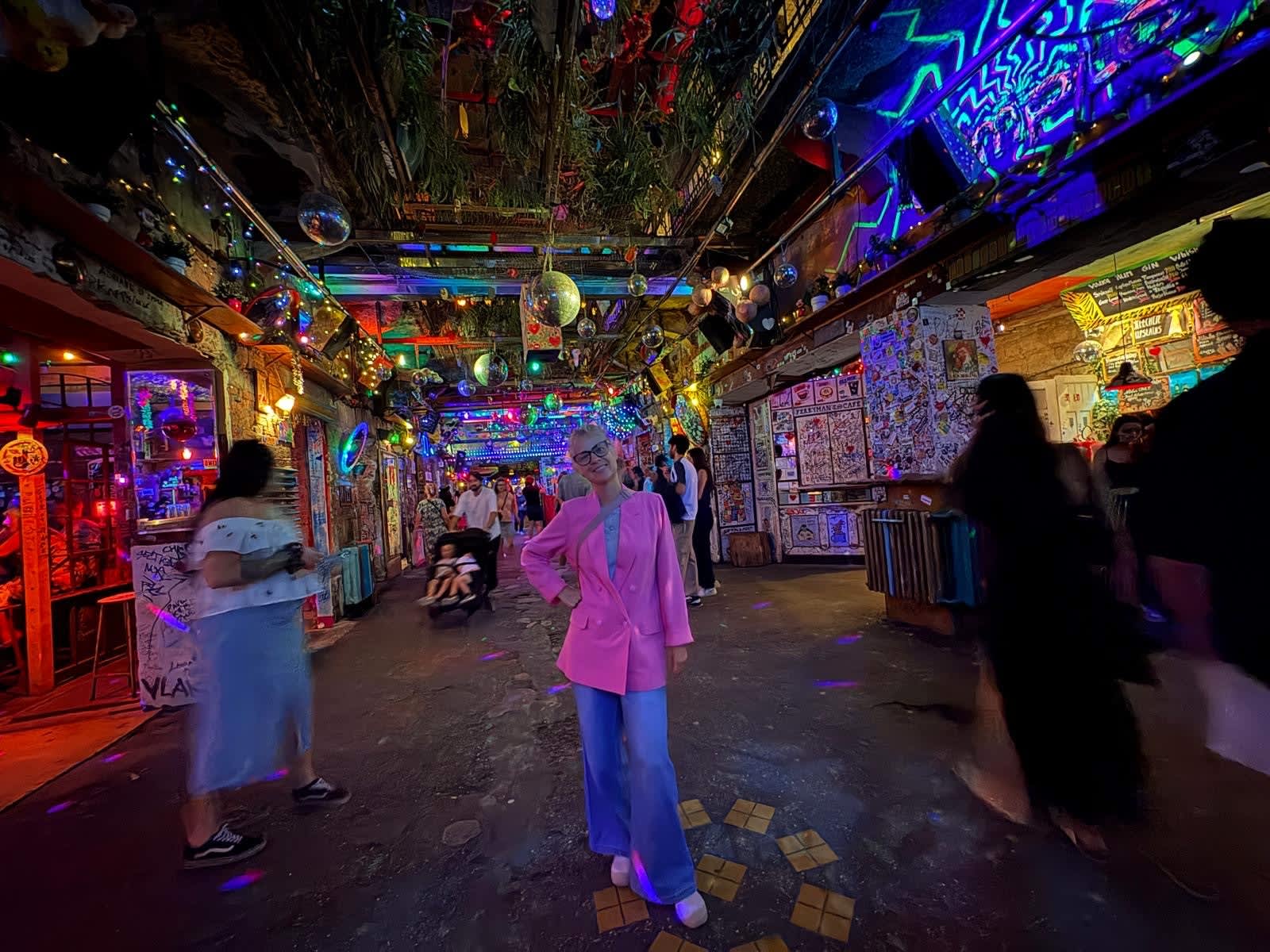
Back in District VII, so-called “ruin bars” — in old residential buildings — offered a fun end to a busy day. After an early evening drink at Szimpla Kert, a riot of neon, fairy lights and mirror balls, I wanted to try Hungary’s traditional food. Korhely, at one end of the pedestrianized Liszt Ferenc square, is a good-value restaurant where the beef stew with dumplings was delicious and filling.
With more time in Budapest, I would go to a concert at the Liszt Academy, opposite Korhely, and visit its galleries and museums, including the Castle District’s Hospital in the Rock — in a former nuclear bunker — and the Museum of Fine Arts next to Heroes’ Square. I’m already looking forward to my next visit.


