


MELBOURNE, Australia and BOSTON, July 29, 2026 /PRNewswire/ — Melbourne- and Boston-based medical device company Navi Medical Technologies has closed a $A6.8 million capital raise to commercialise its breakthrough paediatric vascular access technology in the United States.

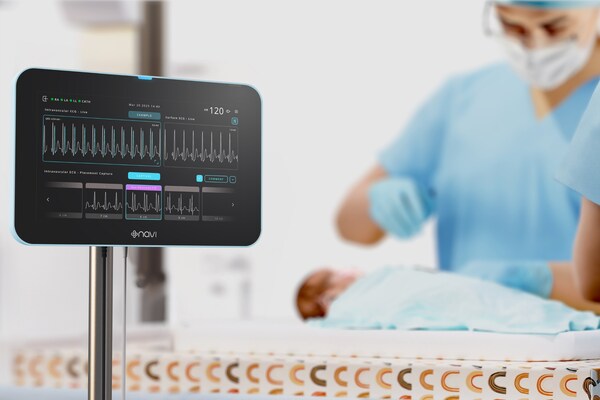
Neonav® ECG Tip Location System in a neonatal clinical setting. Developed by Navi Medical Technologies, Neonav uses real-time intravascular ECG to support central venous access device tip placement and ongoing migration surveillance.
The raise follows US FDA 510(k) clearance and the commencement of clinical evaluations of the company’s Neonav® technology at two leading US children’s hospitals.
The round was led by healthcare venture capital firm KP Rx, which invested $A4 million. Existing investor Innovation Victoria was joined by New Zealand- and Melbourne-based Pacific Channel.
The capital will be used to expand manufacturing, build the company’s US commercial team and support the launch of the Neonav® into leading children’s hospitals.
Commercial sales are expected to commence this year.
The Neonav® addresses one of the most challenging procedures in neonatal and paediatric intensive care – the accurate placement and management of central venous access devices used to deliver nutrition, fluids and medications.
Alex Newton, Chief Executive Officer of Navi Medical Technologies, said: “Neonatal and paediatric clinicians have relied on technologies that were never designed for their smallest patients.”
The misplacement or migration of a catheter can have serious consequences for patients, including damage to the heart or surrounding tissues, which can sometimes be fatal, especially in tiny patients.
ECG-guided catheter placement is standard practice for adult patients in the US, neonatal and paediatric clinicians rely heavily on X-ray confirmation as existing technologies do not adequately address the unique challenges of the smallest patients.
The Neonav® combines real-time ECG-guided catheter placement with ongoing catheter migration surveillance, enabling clinicians to reassess catheter position throughout the use of the catheter – a capability that extends beyond conventional ECG tip location systems and has the potential to improve patient safety while reducing repeat imaging.
The investment follows a defining period for the company. In 2025, the Neonav® received US FDA 510(k) clearance, enabling Navi to enter the world’s largest healthcare market. Clinical evaluations have since commenced with leading US children’s hospitals.
In 2026, Navi received an expanded US FDA indication for use, extending Neonav®’s cleared applications to include additional vascular access procedures for umbilical venous catheters, further strengthening the platform’s commercial opportunity. The Neonav® now has the broadest indications for use for paediatric and neonatal vascular access covering all central venous access devices and procedures.
Hashan De Silva, Partner at KP Rx, said Navi had reached an important commercial inflection point. “Navi has developed a genuinely differentiated technology addressing a significant unmet clinical need. The company has demonstrated exceptional execution – from product development to FDA clearance and early engagement with leading US children’s hospitals. We believe the Neonav® has the potential to become an important new technology in neonatal and paediatric vascular access, and we’re excited to support the team as they scale.”
Alex Newton, Chief Executive Officer of Navi Medical Technologies, said the funding would accelerate the company’s transition from clinical validation to commercialisation.
“For decades, neonatal and paediatric clinicians have relied on technologies that were never designed for their smallest patients. The Neonav® was built to change that.
“This investment allows us to scale manufacturing, grow our US team and partner with leading children’s hospitals as we work to establish a new standard of care in neonatal and paediatric vascular access.”
Rod Bristow, CEO of Innovation Victoria, said the investment demonstrated the global potential of Australian medical technology innovation.
“What stands out about Navi is the quality of both the innovation and the execution. The team has consistently delivered on major milestones and demonstrated that a Victorian company can develop world-leading healthcare technology with global relevance.
“Their progress over the past year has been exceptional, and we’re pleased to continue supporting their growth as they take this technology to more hospitals and more patients around the world.”
Roland Toder, General Partner at Pacific Channel, said Navi’s combination of clinical innovation and commercial execution made it a compelling investment opportunity.
“Navi has developed a highly differentiated technology that addresses a significant unmet need in neonatal and paediatric critical care.
“The team has impressively navigated a demanding clinical and regulatory pathway, achieving important milestones that position the company strongly for future growth and reinforce its potential to establish itself as a global leader in this category.
“We’re excited to support Navi as it enters the next stage of commercial growth in the United States.”
About: Navi Medical Technologies
Founded in Melbourne, Navi Medical Technologies develops next-generation vascular access technologies for neonatal and paediatric care. The company has operations in Australia and the United States and expects to commence US commercial sales in 2026.


